Why Quality & Sterility Matter
Understanding How Manufacturing Standards Support Product Quality
Published by Sano Medical & Skin | Evidence-Informed Patient Education
Every regenerative biologic product has a story that begins long before it reaches a healthcare provider. From donor screening and laboratory processing to preservation, transportation, and storage, each step is designed to help maintain product quality and integrity.
At Sano Medical & Skin, we believe understanding how regenerative biologic products are sourced, processed, and handled is an important part of making informed healthcare decisions. While manufacturing processes may differ between products and manufacturers, transparency and quality systems remain essential considerations.
Why Manufacturing Standards Matter
Regenerative biologic products are complex and require carefully controlled manufacturing processes.
Depending on the product and manufacturer, quality systems may include donor eligibility screening, laboratory processing, quality-control testing, preservation methods, and storage procedures designed to help maintain product consistency.
These processes are intended to support the integrity of the biologic product from manufacturing through clinical use.
Because manufacturing methods vary, patients should feel comfortable asking their healthcare provider about the products being recommended as part of their care.
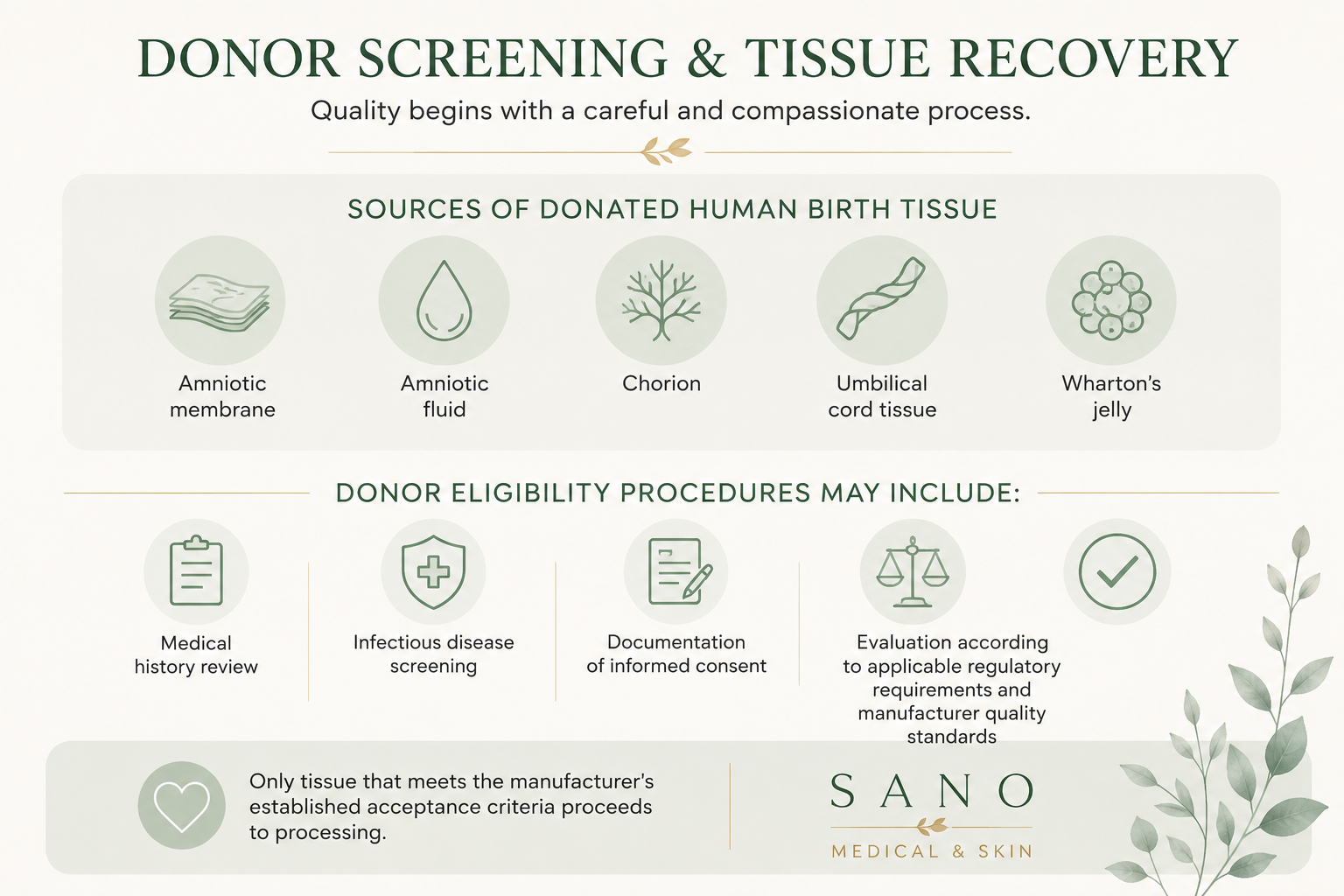
Donor Screening & Tissue Recovery
Many regenerative biologic products are derived from donated human birth tissues, such as:

Laboratory Processing
After tissue recovery, biologic materials are processed using controlled laboratory procedures.
Depending on the product, manufacturing may be designed to preserve naturally occurring biologic components, including:
Extracellular matrix (ECM)
Growth factors
Cytokines
Structural proteins
Hyaluronic acid
Proteoglycans
Extracellular vesicles
Cellular components (when applicable)
Processing methods differ between products and manufacturers.
Quality Control & Product Testing
Before a regenerative biologic product is released, manufacturers may perform quality-control assessments designed to evaluate product characteristics.
Depending on the product, these evaluations may include:
Sterility testing
Endotoxin testing
Identity verification
Quality assurance review
Cell characterization (when applicable)
Viability assessment (for products containing living cells)
Testing protocols vary by manufacturer and product type.
Preservation & Storage
Some regenerative biologic products require specialized preservation and storage conditions.
Depending on the product, manufacturers may specify:
Refrigerated storage
Frozen storage
Cryogenic preservation
Controlled transportation procedures
Following the manufacturer's storage and handling instructions is an important part of maintaining product integrity before clinical use.
Questions Patients May Wish to Ask
If you are considering regenerative medicine, consider discussing the following questions with your healthcare provider:
What type of regenerative biologic product are you recommending?
How is the product manufactured?
How is it stored before treatment?
What quality-control procedures does the manufacturer perform?
What published scientific evidence supports the product's intended use?
What are the potential benefits, limitations, and alternative treatment options?
These conversations can help patients better understand the products being considered as part of their individualized care.
Why Transparency Matters
Patients deserve clear, balanced information about the products used in their care.
Understanding how regenerative biologic products are sourced, processed, preserved, and handled allows patients to participate more confidently in shared decision-making with their healthcare provider.
At Sano Medical & Skin, we are committed to patient education and evidence-informed discussions that support thoughtful healthcare decisions.
Final Thoughts
Quality begins long before treatment.
From donor screening and laboratory processing to preservation and storage, every step contributes to the overall handling of regenerative biologic products.
Learning about these processes can help patients ask informed questions and better understand the products recommended by their healthcare provider.
References
U.S. Food and Drug Administration. Human Cells, Tissues, and Cellular and Tissue-Based Products (HCT/Ps).
American Association of Tissue Banks (AATB). Standards for Tissue Banking.
U.S. Food and Drug Administration. Current Good Tissue Practice (CGTP).
International Society for Cell & Gene Therapy (ISCT). Educational resources.
U.S. Food and Drug Administration. Current Good Manufacturing Practice (cGMP).
Educational Disclaimer
This article is provided for educational purposes only and is not intended as medical advice. The information presented is designed to improve understanding of regenerative biologic products and should not be interpreted as a claim that any product diagnoses, treats, cures, or prevents disease. Manufacturing processes, preservation methods, and regulatory pathways vary by product. Individual treatment recommendations should always be based on a comprehensive evaluation performed by a licensed healthcare professional. Scientific knowledge continues to evolve, and recommendations may change as additional evidence becomes available.